

Nicosia · urban heat island
The city changes
with the clock.
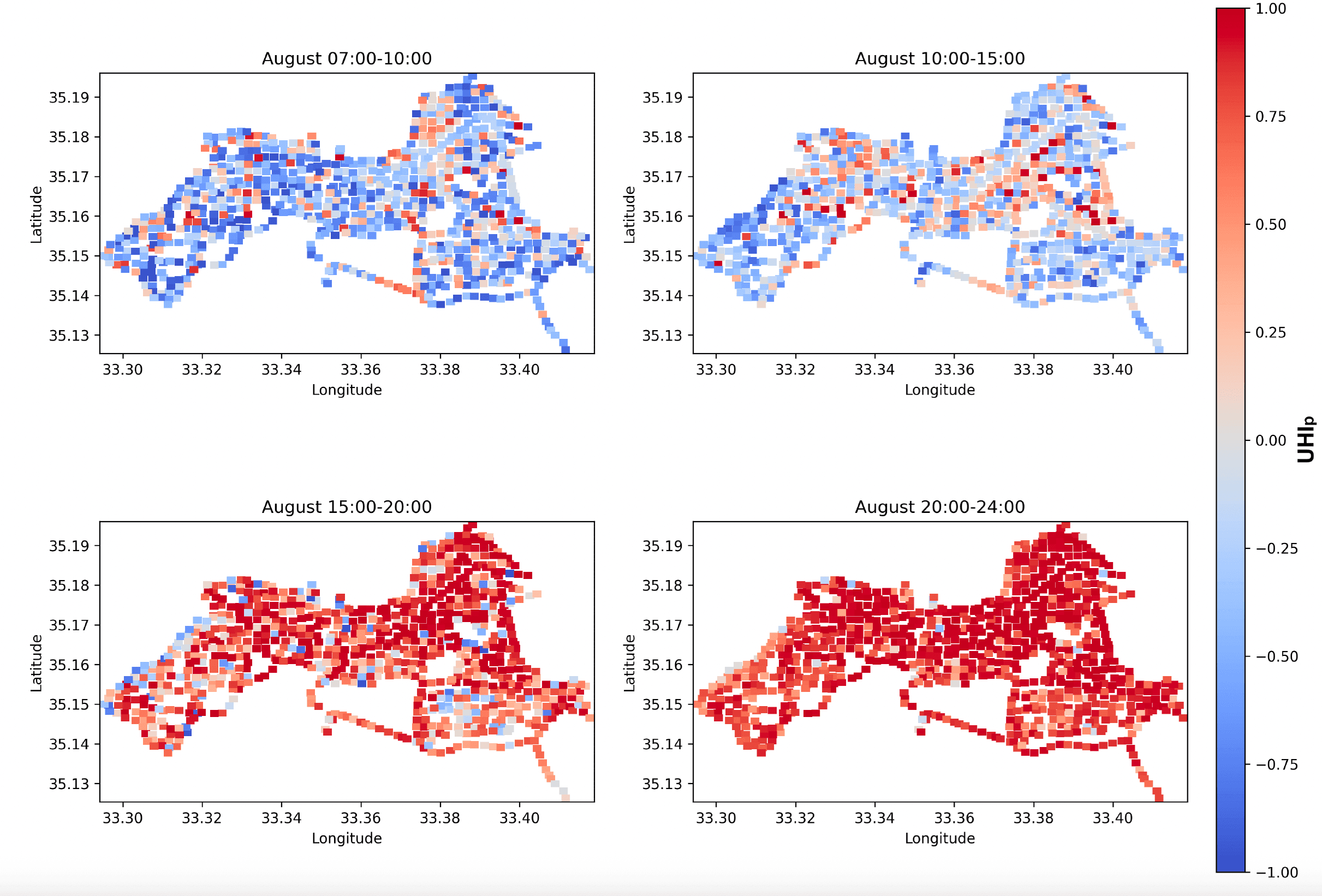
Municipal vehicles turned their everyday routes into a moving temperature survey. The resulting study shows that Nicosia is not simply hotter than its surroundings all day: its heat-island pattern builds, shifts, and sometimes reverses over a matter of hours.
The central finding
The hottest day does not always produce the strongest urban-rural difference.
Two roof-mounted systems recorded location, air temperature, and wind while Nicosia Municipality crews followed their normal routes during August and September 2025. The measurements were compared with the Athalassa reference station and used to train a hybrid model combining climate physics with deep learning.
The model separates each area's underlying UHI potential from the weather conditions that activate it. During the extreme heatwave of 9-11 August, when temperatures exceeded 42 °C, the urban-rural difference almost disappeared because the surrounding rural landscape had also become exceptionally hot. Heat stress remained severe, but the UHI contrast was weaker.
Validation against six independent weather stations produced a mean absolute error between 0.25 and 1.09 °C, supporting the model's use for neighbourhood-scale interpretation while retaining the uncertainty expected from mobile measurements.
Parts of the city begin cooler
Blue cells dominate much of the morning map. Building shade and the slower warming of urban surfaces can briefly create an urban cool-island pattern.
Stored heat changes the picture
As streets, roofs, and walls absorb solar energy, warmer clusters spread across the city. Central Nicosia can become roughly 2.5-3 °C warmer than the rural reference area.
The heat island becomes widespread
Built surfaces release stored heat after sunset, producing the clearest and most spatially consistent positive UHI potential of the day.
Why this matters
Cooling measures can be placed where stored heat persists.
Open spaces, the Pedieos River corridor, and areas with more tree cover appeared cooler. Dense concrete development and the sparsely vegetated SOPAZ industrial area showed stronger heat-island behaviour. That contrast can help guide shade, tree planting, green space, and cool-material interventions.